Ten days in Italy sounds like plenty until you open a map and realize you want to be in six places at once. We’ve built this guide to cut through that paralysis: a clear route, honest daily costs, and the transit steps most itineraries quietly skip. Follow it in order and you’ll land in Italy with a plan, not a wishlist.
Step 1: Pick travel dates and main entry point
Your dates shape everything else, so lock them before you touch a map. Our research across 20 Italy itineraries found that early-to-mid fall (mid-September through October) comes up most often as the preferred window. The heat has dropped, the summer crowds have thinned, and prices on accommodation tend to follow suit.
Spring (late April through early June) is the other strong window. Both seasons give you comfortable walking weather, which matters when you’re logging 4 to 8 miles a day on cobblestones.
Avoid the first two weeks of August if you can. Many smaller restaurants and shops close for Ferragosto, and the major sites get genuinely uncomfortable. December through February is quiet and cheap, but some coastal areas and smaller towns go into a kind of hibernation.
For entry point, Rome’s Leonardo da Vinci, Fiumicino Airport (FCO) and Venice’s Marco Polo Airport (VCE) are the two most useful for a classic north-to-south or south-to-north route. If you can book an open-jaw flight , arriving into one and departing from the other , you cut out all backtracking. That single decision can save you half a day of transit. Milan’s Malpensa (MXP) works well if you want to start in the north and work your way down.
Check the cheapest months to fly to Europe before you commit to dates , the difference between a Tuesday in October and a Friday in late July can be several hundred dollars on the same route.
Once you have a rough window, set a price alert on a flight search engine for your top two airport combinations. Fares to Italy tend to drop several weeks out for shoulder-season travel, but for summer you want to book a few months ahead.
Pro Tip: Book an open-jaw flight (fly into Rome FCO, out of Venice VCE, or vice versa) to avoid paying for a return train journey at the end of your trip. The price difference is usually small and the time saved is real.
Step 2: Group destinations into regional clusters
Italy’s geography punishes itineraries that ignore it. The country stretches from the Alps in the north to the tip of the boot in the south, and trying to cover too much of it in 10 days means you spend more time on trains than in piazzas.
The most usable approach for a first-time 10-day trip is to pick three anchor cities and cluster day trips around each one. For most travelers, that means Rome, Florence, and Venice. They sit on Italy’s main high-speed rail spine, each one is genuinely worth two to three days on its own, and Florence in particular is an excellent base for reaching Siena, Pisa, or the Cinque Terre without moving your luggage.
Here’s how to think about the clusters:
South cluster (Rome base): Rome itself takes at least two full days. From here you can reach Pompeii and Naples in under 90 minutes by high-speed train. The Amalfi Coast is doable as a long day trip from a Naples base, though staying overnight in Sorrento gives you more breathing room.
Central cluster (Florence base): Two days in Florence, then a day trip to Siena or the Cinque Terre. Pisa is an easy half-day from Florence’s Santa Maria Novella station. Bologna is 35 minutes away by high-speed train and consistently underrated by first-timers. Our guide to the best gelato in Florence highlights eight spots worth the line if you need a sweet break.
North cluster (Venice base): Venice needs two days minimum. Verona is 70 minutes away and makes a strong half-day add-on. Lake Como and the Dolomites are worth a dedicated trip rather than a rushed day out.
Travel guides often suggest the classic train-based route runs Venice, Cinque Terre, Florence, then Rome, with the cluster south of Rome (Naples, Pompeii, Sorrento, Amalfi) as an optional extension. That north-to-south flow works well because it matches the natural direction of Italy’s high-speed network and avoids backtracking.
One honest caveat: if you try to include both the Dolomites and the Amalfi Coast in 10 days, something will feel rushed. Pick one for this trip and save the other for your return. We recommend making that call before you book any accommodation.
For a deeper look at which cities deserve the most time, our guide to the must-see cities in Italy gives honest verdicts on what each place is actually like, including what’s overrated.
Step 3: Day-by-day itinerary with activities
Here’s a day-by-day framework built around the Rome-Florence-Venice spine. Adjust based on your entry point and which cluster you want to extend.
Days 1-3: Rome
Fly into FCO. Day 1 is for arrival, orientation, and the neighborhood around your accommodation. Don’t try to hit a major site on arrival day. Day 2: the Vatican Museums, Sistine Chapel, and St. Peter’s Basilica. Book timed entry in advance , walk-up queues can run two hours. Day 3: the Colosseum, the Roman Forum, and Palatine Hill. These are sold together on one ticket. Buy it online at least a week ahead.
Split those two big attractions across separate days on purpose. Trying to do the Vatican and the Colosseum in one go will leave you too tired to take anything in properly by mid-afternoon.
Days 4-5: Naples day trip, then travel to Florence
Day 4: take a high-speed train to Naples (about 70 minutes from Rome Termini) and connect to Pompeii via a local commuter train. Budget three hours at the site. Return to Rome for the night. Day 5: morning high-speed train to Florence (about 90 minutes). Check in, then walk to the Duomo and Piazza della Signoria to get your bearings.
Days 6-7: Florence and a day trip
Day 6: the Uffizi Gallery in the morning (pre-booked tickets only , same-day entry is nearly impossible in peak season) and the Accademia for Michelangelo’s David in the late afternoon. Day 7: day trip to Siena or the Cinque Terre. Siena is 90 minutes by bus from Florence’s Santa Maria Novella station. The Cinque Terre is about 2.5 hours by train. Both are worth it; Cinque Terre is more scenic, Siena is more manageable in a single day.
Days 8-10: Venice
Train from Florence to Venice takes about 2 hours on the high-speed service. Day 8: arrive, drop luggage, and walk. St. Mark’s Square, the Rialto Bridge, and a cicchetti crawl through the backstreets. Day 9: St. Mark’s Basilica and the Doge’s Palace in the morning (both need pre-booked tickets). Afternoon free for the Accademia gallery or a vaporetto ride out to Murano. Day 10: morning departure from Venice Marco Polo.
For everything Venice specifically has to offer, including which attractions are worth the queue and which aren’t, our full guide to things to do in Venice covers it with real prices and honest verdicts.
Key Takeaway: Split your two biggest attractions in each city across separate days , trying to stack them back-to-back is the single most common mistake on a first Italy trip.
Step 4: Detailed budget breakdown
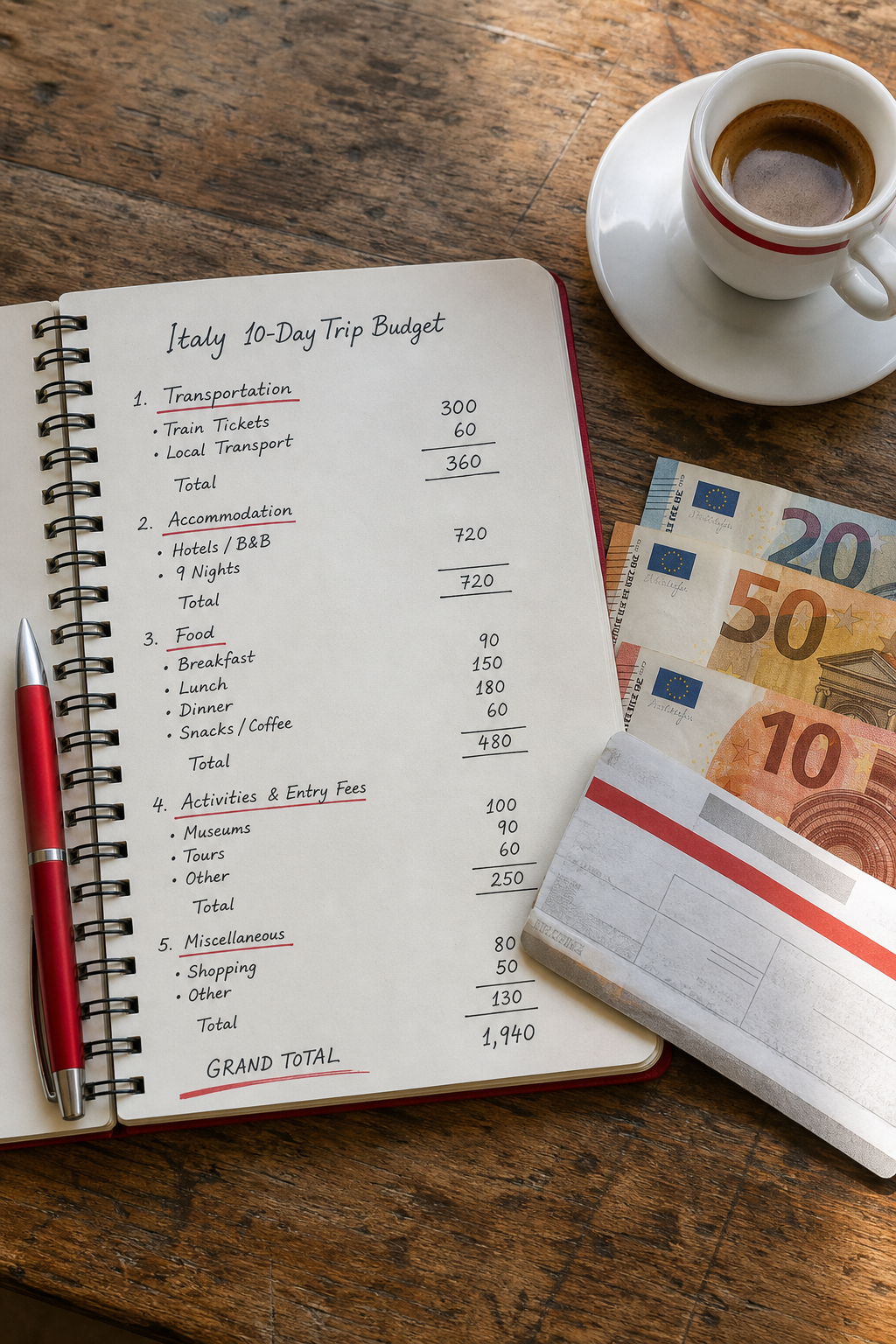
Most Italy itineraries online don’t tell you what things actually cost. We do. The figures below are based on a mid-range independent traveler spending carefully but not suffering, decent accommodation, sit-down meals at lunch and dinner, paid attractions, and trains booked in advance.
Accommodation
Rates vary by season and location, with two- or three‑star hotels and quality guesthouses offering a range of options. In Venice, prices tend toward the higher end, while Rome and Florence provide solid mid‑range choices when booked several weeks in advance.
Transport
Inter‑city trains are the main cost here. High‑speed services between major cities can be booked in advance for reasonable fares. Regional connections, such as the route to Pompeii, require a separate local train ticket. Overall, inter‑city rail and local transit together represent a significant portion of the travel budget, with additional costs for airport transfers.
Italy’s high‑speed network is operated by national rail providers. Both serve the main Milan‑Venice‑Florence‑Rome‑Naples corridor. Checking multiple operators before you book can reveal price differences.
One important note on Pompeii: it’s not on the main rail network. Purchase a ticket to Naples Centrale, then a separate ticket for the regional train service to reach the site.
Food
Breakfast in Italy is inexpensive, especially when enjoyed at a bar. Sit‑down breakfasts cost a bit more. Lunch at a trattoria and dinner at a mid‑range restaurant are affordable when you choose local dishes and wine. Overall, budgeting for food allows flexibility for both sit‑down meals and street‑food options.
Attractions
Tickets are required for major sites such as the Colosseum complex, the Vatican Museums, the Uffizi, and the Accademia. Admission fees vary by season and whether you purchase online in advance.
Total estimate
A realistic 10‑day budget for one person, excluding flights, depends on accommodation choices, dining preferences, and transportation options. The Dream Book Travel editorial team uses a flexible daily budget range that can be adjusted based on individual travel style.
Step 5: Booking tips, tools and timing
The single biggest mistake we see on Italy trips is treating train tickets as something you sort out when you arrive. Don’t. High-speed trains require seat reservations, and the cheapest fares sell out weeks in advance. Booking opens up to four months ahead on the official rail website.
For attraction tickets, the rule is simple: if it’s in Rome or Florence and it’s famous, book it before you leave home. The Vatican Museums, Colosseum, Uffizi, and Accademia all have timed entry systems. Walk-up availability exists but it’s unreliable, especially May through September.
On rail passes
A rail pass is not a good fit for most 10‑day Italy trips. Most point‑to‑point tickets on the Milan‑Venice‑Florence‑Rome circuit are inexpensive, which means a pass that costs a significant amount per day rarely pays off. Additionally, the fastest trains still require paid seat reservations even with a pass, removing the main convenience benefit. Buy point‑to‑point tickets and book them early.
The one exception: if your Italy trip connects to a broader European rail journey (for example, continuing to France or Spain), a multi‑country rail pass may save money overall. Run the numbers for your specific route before buying.
Tools worth using
For trains, use online booking platforms to compare operator prices side by side. For accommodation, filter by cancellation policy and book refundable rates until your plans are firm. For attraction tickets, go directly to the official museum or site; third‑party resellers charge a markup and occasionally have inventory issues.
Dream Book Travel’s planning guides are built around the same principle: direct, transparent, no invented prices. If you’re still deciding on your wider European routing before Italy, our roundup of the best places to visit in Europe gives honest context on how Italy fits against other destinations, which can help you decide whether to extend the trip.
What to book and when
Flights: 3 to 4 months out for summer; 6 to 10 weeks out for shoulder season.
High-speed trains: As soon as your dates are fixed. Cheapest fares go first.
Vatican Museums: At least 3 to 4 weeks ahead; earlier in peak season.
Colosseum: 2 to 3 weeks ahead minimum.
Uffizi and Accademia: 1 to 2 weeks ahead is usually enough outside of July and August.
Accommodation: 6 to 8 weeks out for mid-range; earlier for Venice in summer.
One honest limitation to flag: Italian trains run late more often than the schedule suggests, especially regional services. Build buffer time on any day where you have a timed attraction booking after a train journey. Missing a pre‑paid Vatican slot because of a delayed regional train is a real risk, not a theoretical one.
FAQ
Is 10 days enough for Italy?
Ten days is enough to see three major cities well and add one or two day trips. It’s not enough to cover the whole country, and that’s fine. Rome, Florence, and Venice alone will keep you genuinely busy for 10 days if you don’t rush. Resist the urge to add more stops, you’ll enjoy what you do see much more.
What’s the best order to visit Rome, Florence, and Venice?
South to north (Rome first, Venice last) works well if you fly into Rome FCO and out of Venice VCE. North to south works equally well in reverse. The key is avoiding backtracking. Don’t fly into Rome, go to Venice, return to Florence, then back to Rome, that wastes a full day of your trip on trains you’ve already paid for.
How much does a 10-day Italy trip cost per person?
A mid-range independent trip typically costs a few thousand euros per person, excluding flights. This covers comfortable hotels, inter-city trains booked in advance, paid attractions at major sites, and meals at sit‑down restaurants. Budget travelers can lower costs by staying in hostels and eating street food, though there is a realistic minimum daily spend.
Do I need to book Italy trains in advance?
Yes, especially high‑speed services. These trains usually require seat reservations and the cheapest fares sell out weeks ahead, so book as soon as your dates are confirmed. Regional trains (such as those serving local destinations) generally do not require advance booking, but high‑speed inter‑city routes do if you want to control your cost and schedule.
What’s overrated in Italy for a 10-day trip?
The Leaning Tower of Pisa is a quick photo stop, not a half‑day destination, most travelers feel done in 45 minutes. The Trevi Fountain is worth seeing but the surrounding area is heavily touristed and overpriced. Lake Como is genuinely worth a trip, but it’s better as a dedicated 2‑night stay than a rushed day trip from Milan squeezed into a 10‑day itinerary that already includes Rome, Florence, and Venice.
Should I rent a car in Italy for 10 days?
No, not if you’re following a Rome‑Florence‑Venice route. A car is a liability in Italian cities, parking is expensive, ZTL restricted zones carry automatic fines, and you’ll spend more time managing the car than enjoying the trip. The high‑speed train network connects all three cities faster and cheaper. A car makes sense only if you’re spending several days in rural Tuscany or the Dolomites specifically.
Final Thoughts
The itinerary above gives you a working plan, not a fantasy. Three anchor cities, trains booked in advance, attractions pre‑reserved, and a realistic daily budget that fits a mid‑range traveler. That’s what a well‑run 10‑day Italy trip actually looks ```
For deeper planning, explore the Dream Book & Travel portal where you can find more city guides and tools to fine‑tune your adventure.
If you want to go deeper on any single city before you book, Dream Book Travel's city guides cover the specifics with the same level of honesty, real prices, what to skip, and what's genuinely worth your time.
The calm, specific solo female travel safety tips I actually use, grounded in real government advisories and dated July 2026. No fear, no false promises.
Verdict: No tip makes you untouchable, but real preparation quiets most of the fear and handles most of the risk.
Solo travel after divorce from a woman who left a marriage and a career at 40. Why it helps, where to go first, and the hard parts nobody warns you about.
Verdict: Solo travel after divorce will not fix the hard parts, but it hands you back the one thing a long marriage can quietly take: the proof that you can do this on your own.