Travel Apps: What to Use for Every Trip
Find the best travel apps for flights, bookings, itineraries, transit, and travel days, with honest trade-offs and clear recommendations.
Verdict: Cancun is a reasonable, well-supported choice for a solo woman who stays in the Hotel Zone or the main center, plans her transport instead of hailing random cabs, and applies nightlife caution. The real risks are mostly not violent, they are taxi overcharging, petty theft, and drink safety. Quintana Roo sits at US State Department Level 2 as of August 2025, the same level as France and the UK. Know your ride home before you go out.

Is Cancun safe for a solo female traveller? For most women, in most of the places you will actually spend your time, yes, and I am going to give you the honest version of that rather than the one that tells you everything is perfect or the one that tells you to cancel your flight. The truth sits in between, which is where it usually does. Cancun is one of the more supported places a woman can travel alone in Mexico, with a whole tourist economy built to keep visitors comfortable, and it still asks you to make a few deliberate choices you would not have to make at a resort in, say, Portugal.
Let me walk you through what the advisories actually say, which zones are which, the risks that are real versus the ones that get exaggerated, and the specific things I would do if I were landing there alone next week.
All safety information here was checked against current sources as of August 2026. Safety situations change. Check the US State Department advisory and your own government’s guidance before you book and again the week you fly.
Start with the number, because it anchors everything else. The US State Department rates travel by Mexican state, and Cancun sits in Quintana Roo, which is currently Level 2: Exercise Increased Caution. That rating was last updated in August 2025, and the important detail is that the level did not go up. The language was revised to reflect the early-2025 designation of certain cartels as foreign terrorist organizations, but Quintana Roo stayed at Level 2 and did not escalate to Level 3.
Here is the context that a Level 2 headline never gives you on its own: Level 2 is the same rating the State Department currently applies to France, Italy, Germany, Spain, and the United Kingdom. It is a broad, common designation, not a red flag specific to Cancun. It means exercise increased caution, not do not travel. What it does flag is that crime, including cartel-related activity, exists in the state, and that reality mostly plays out away from the tourist strip rather than on it.
None of that is a promise. Read the actual advisory text at travel.state.gov, note its date, and check it again before you go. An advisory that is calm when you book can shift, and “safe” is not a thing I get to guarantee you. What I can tell you is that as of now, the paperwork puts Cancun in the same tier as a European city break.
Cancun is really two places, and knowing which one you are in explains most of the safety advice you will read.
This is the long, narrow strip of resorts, beaches, and restaurants between the lagoon and the Caribbean, and it is where most solo women stay. It is the most monitored part of the city, with gated resorts, on-site security, tourist police, and a lot of other visitors around at all hours. This is the safest base, and if this is your first solo trip or your first time in Mexico, this is where I would put you. Walking the main hotel strip in the evening is generally fine. The beaches are public and busy through the day.

Centro is the real, lived-in city where locals actually live and eat, and it is where the good cheap food and the more authentic feel are. It is budget-friendly and worth a visit. The honest caveat is that it is not uniformly well-lit, and some downtown neighborhoods carry more risk than the tourist strip, which is where the “avoid downtown at night” advice comes from. By day, in the main center, it is manageable and interesting. After dark, be more deliberate about where you are and how you are getting back. Staying in a hotel there rather than a tucked-away rental gives you a bit more of a security layer.
The pattern to internalize: the further you get from the tourist infrastructure, the more the ordinary rules of a big Mexican city apply, and the closer you stay to it, the more cushioned you are.
Here is what solo women in Cancun genuinely run into, in rough order of how likely it is to touch your trip.
Taxi overcharging. This is the number-one hassle, not violence. Cancun taxis do not run meters, and drivers are well known to quote tourists inflated fares. Agree the price before you get in, every single time, and know roughly what the ride should cost. This is annoying far more often than it is dangerous, but it is the thing you will bump into most.
Petty theft. Pickpocketing and opportunistic theft happen in crowds, at markets, and around nightlife, the same as in any major tourist city. Do not leave a bag unattended on the beach, do not flash jewelry or a fat roll of cash, and keep your phone secure in busy areas.
Drink safety in nightlife. The party scene is a big part of Cancun, and the honest read from women who go there is that the thing to watch is not violent crime, it is the ordinary nightlife stuff, drink spiking and heavily intoxicated strangers. Never accept a drink from a stranger or leave yours unattended, even with someone charming. One traveler put it plainly on the forums: there are far more drunk tourists to navigate than locals to worry about.
Catcalling. You may get some comments or unwanted attention. Women who travel there consistently describe it as present but not invasive or threatening. A firm no with direct eye contact, and the habit of walking like you know exactly where you are going, handles most of it.
Cartel activity. This is the headline that scares people, and it is worth being straight about. It exists in the state, it is the reason for the Level 2 rating, and it overwhelmingly plays out away from the tourist zones. The practical version for you is simple: do not buy drugs, do not go looking for the parts of that world, and stay within the well-traveled areas. For a tourist keeping to the Hotel Zone and normal day trips, it is not the thing shaping your day.
Your transport plan is most of your safety plan in Cancun, so make it before you go out, not at 1 a.m. on a dark corner.
Airport transfer. Do not grab a random taxi at the airport, and note that ride-hail apps cannot legally pick up there. Book a private shuttle or a pre-arranged transfer in advance. A shared or private transfer to the Hotel Zone is the calm, priced-in-advance option, roughly in the sixty-dollar range round trip for a private car, and it takes the arrival-day guesswork out.
Taxis. Fine to use, no meters, so agree the fare first. Have small bills, and pay in pesos rather than dollars for a better rate.
Ride-hail apps. Uber operates in Cancun and is legal, though it is used less than in other Mexican cities and there is long-standing friction between app drivers and the taxi union. Where it is available, a lot of solo women prefer it after dark because the price and route are logged. The broad rule women use across Mexico is to take a ride-hail as soon as it gets dark rather than walk unfamiliar streets.
ADO buses. For getting between towns, the ADO intercity buses are the solo traveler’s backbone here. They are safe, comfortable, and cheap, with air-conditioning, reclining seats, and a bathroom, and they run direct routes to places like Tulum and Playa del Carmen. Highly recommended.
Getting between the Hotel Zone and downtown. The public R-1 bus runs the strip and out to the ADO station and Centro cheaply, and it is a normal, fine way to move around in daylight.
ATMs. Use ATMs inside banks or the one at the airport rather than free-standing street machines, which are more prone to skimming and junk fees. Withdraw enough for a day or two at a time so you are not hunting for cash constantly.
Being solo in Cancun does not mean sitting by the pool. The area is genuinely easy to explore on your own.
Isla Mujeres is the standout solo day trip. It is a short thirty-minute ferry from the Hotel Zone on a well-run line like Ultramar, and the island is small, relaxed, and walkable, with Playa Norte’s shallow turquoise water at the top of the island. You do not need a car, and you can happily spend a day there alone.
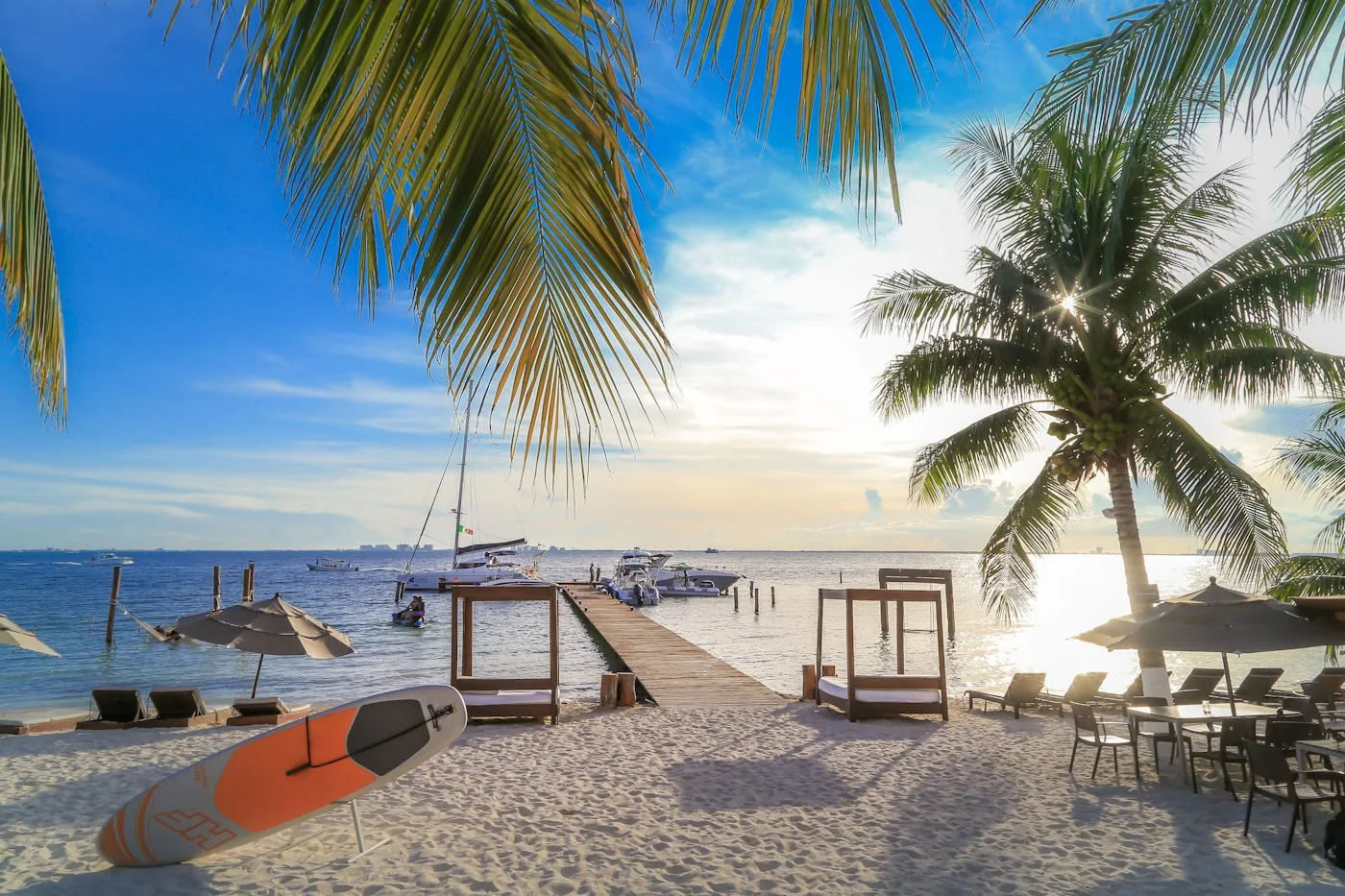
The ruins. El Rey is a small archaeological site right inside the Hotel Zone if you want history without a big journey. For the famous Tulum ruins, you can take the ADO bus down and back safely in a day, or join an organized tour that bundles it with a cenote or Xel-Ha.
Cenotes and day tours. The organized-tour format is a good one for a solo woman here. It hands you company, transport, and a guide who knows the ground, and it takes the logistics off your plate for the day. If independent driving in an unfamiliar region is what makes you nervous, this is the format to lean on.
Is Cancun safe for a solo female traveller? For a woman who stays in the Hotel Zone or the main center, plans her transport instead of trusting random cabs, and applies the ordinary nightlife caution she would anywhere, it is a reasonable and well-supported place to travel alone, and plenty of women go back again and again. The advisory has it at the same level as a European city, and the risks you will most likely meet are overcharging cabs, petty theft, and the party scene, not the violence the headlines imply.
Do not go in fearless, and do not go in terrified either. Go in prepared. Know your ride home before you go out, keep your drink in your hand, tell someone where you are, and check the current advisory yourself before you book. If you want to keep reading, I have a broader piece on solo female travel safety tips and one on whether Mexico as a whole is safe for solo women. Then go. Cancun is easier than its reputation, and it is waiting for you.
Find the best travel apps for flights, bookings, itineraries, transit, and travel days, with honest trade-offs and clear recommendations.
Use these travel planning tips to set a realistic budget, choose the right pace, book smarter, and build an itinerary you will enjoy.
Hostel vs hotel for solo female travelers: real price figures, safety comparison, and Maren's honest recommendation including the private hostel room option.